
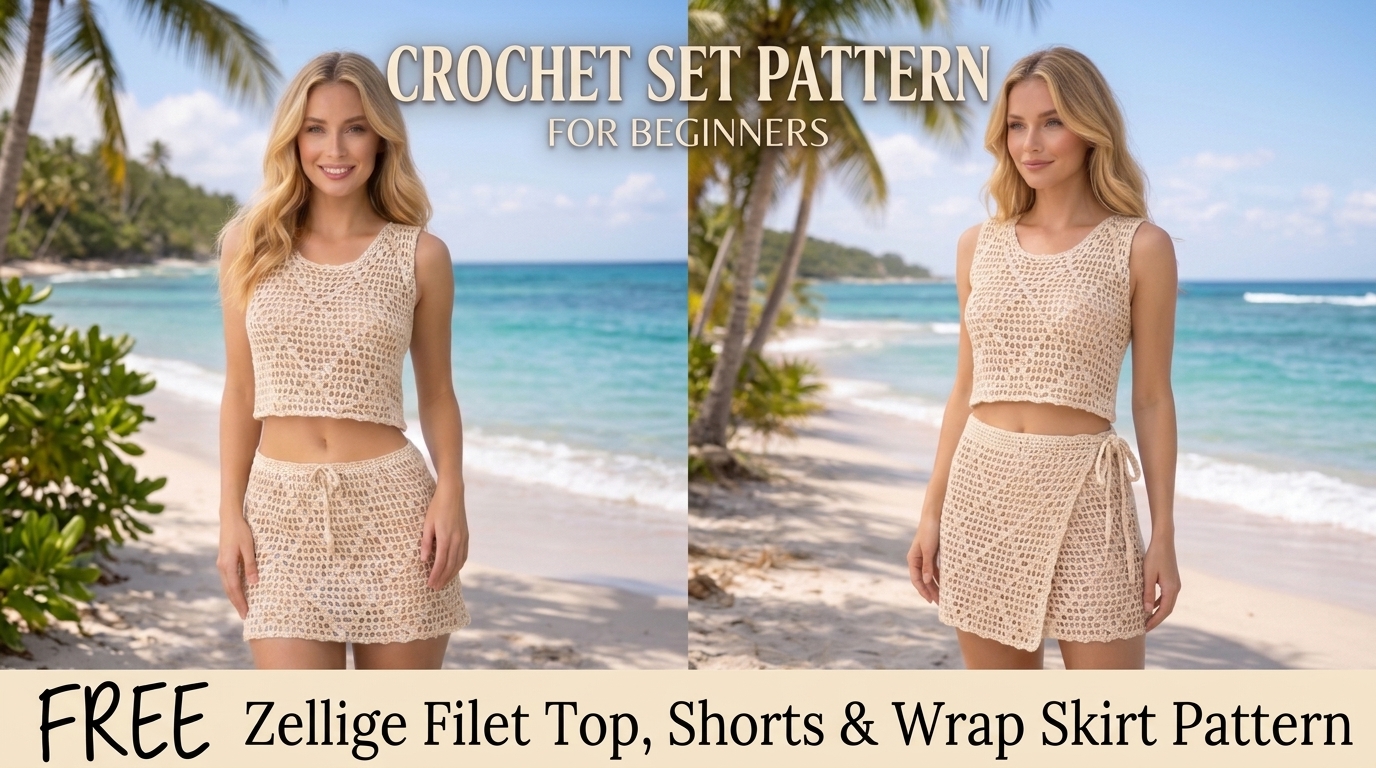
Looking for a crochet set pattern that is free, beginner friendly and not another granny square co-ord? The Zellige Filet Resort Set is a three-piece crochet set: a halter top, drawstring shorts and a wrap skirt cover-up. Everything is made from chains and double crochet. It comes in 7 sizes (XS to 3XL) and 3 skill levels, and the hem carries an eight-pointed star inspired by Moroccan zellige tilework.
The full written pattern is on this page. You can also download the free printable PDF with both charts and every size table.
- Skill level: beginner friendly (3 optional levels)
- Sizes: XS, S, M, L, XL, 2XL, 3XL
- Hook: 3.5 mm (US E-4) to start, adjust to gauge
- Yarn: DK or sport weight mercerized cotton, about 530 to 870 m for the whole set
- Gauge: 6 squares x 8 rows = 10 cm (4 in)
- Techniques: chain, double crochet, slip stitch, single crochet edging. Almost no sewing.
Quick answer: a crochet set (also called a co-ord) is a matching top plus shorts or a skirt. This one is worked in filet crochet, so each piece is just a grid of open and solid squares.
In this pattern guide:
What is filet crochet (and why is it good for a beginner crochet set)?
Filet crochet is a way of crocheting a grid. Each square of the grid is either open (a space made with a chain 2) or filled (a block of 3 double crochet). Pictures and patterns appear when you fill some squares and leave others open, like pixels.
That makes it a friendly place to start. There are only two building blocks to learn, you can see your progress row by row, and charts are easy to follow because every box on the chart is one square in your work.
Quick note for new crocheters: the word crochet comes from the French word for a small hook, and it is pronounced kroh-SHAY. Crochet makes fabric by pulling loops through loops with a single hook, while knitting uses two needles. If you are brand new, start with our ultimate beginner crochet guide and the magic ring tutorial.
Why zellige? Zellige is the traditional Moroccan mosaic of hand-cut glazed tiles, and the eight-pointed star is one of its best-known shapes. A mosaic and a filet chart are cousins: both are grids that make a picture by filling in some cells. That is why the Zellige Star and Zellige Lattice in this set work so naturally in filet.
The set at a glance
The Zellige Filet Resort Set is a three-piece beach and summer set: a halter top, drawstring shorts and a wrap skirt cover-up. Every piece is worked in filet crochet, which is just chains and double crochet arranged as open spaces and solid blocks. The motifs are inspired by the eight-pointed stars of Moroccan zellige tilework.
- Skill level: beginner friendly. Three optional levels, see below.
- Sizes: XS, S, M, L, XL, 2XL, 3XL.
- Yarn: DK or sport weight mercerized cotton.
- Hook: 3.5 mm (US E-4) to start. Your gauge decides the final hook.
- Gauge: 6 squares x 8 rows = 10 cm (4 in) in filet mesh.
- Construction: top and skirt are flat rectangles. Shorts are worked top down in the round. Almost no sewing.
| Level | Who it is for | What you crochet | Skills used |
|---|---|---|---|
| Level 1: Plain Mesh | Total beginners | Every piece in plain filet mesh with solid block borders and ties. | Chain, double crochet, slip stitch, single crochet |
| Level 2: Lattice | Confident beginners | Level 1, plus a 6-row Zellige Lattice band on the top, the shorts hems and the skirt. | Level 1, plus following a simple repeat |
| Level 3: Star Band | Chart readers | Level 2, plus a row of four Zellige Stars along the skirt hem. | Level 2, plus reading a filet chart |
Crochet for beginners: which level should I start with?
If you have never made a garment, start with Level 1 on the skirt, which is a plain rectangle. When you can keep your square count steady, add the lattice band (Level 2). When you are comfortable reading a chart, try the star band (Level 3). The pieces are independent, so you can make the top at Level 1 and the skirt at Level 3.
Materials
- Yarn: DK or sport weight 100% mercerized cotton. About 115 m per 50 g is typical. One colour is enough. Yardage by size is in the table below. Buy a little extra, around 10 to 15 percent.
- Hook: 3.5 mm (US E-4) to start. Move up or down after your swatch.
- Notions: tapestry needle, scissors, measuring tape, 4 stitch markers, pins and a blocking mat (or clean towels).
- Optional: a contrast colour for the hem band and ties, and a fabric stiffener for the star band.
| Size | XS | S | M | L | XL | 2XL | 3XL |
|---|---|---|---|---|---|---|---|
| Top (m / g) | 40 / 20 | 50 / 20 | 60 / 25 | 60 / 30 | 70 / 35 | 90 / 40 | 100 / 40 |
| Shorts (m / g) | 180 / 75 | 200 / 85 | 220 / 95 | 240 / 105 | 270 / 120 | 300 / 130 | 330 / 145 |
| Skirt (m / g) | 310 / 135 | 330 / 145 | 350 / 155 | 370 / 165 | 400 / 170 | 420 / 180 | 440 / 190 |
| Whole set (m / g) | 530 / 230 | 580 / 250 | 630 / 275 | 670 / 300 | 740 / 325 | 810 / 350 | 870 / 375 |
| Whole set (yards) | 580 | 630 | 690 | 730 | 810 | 890 | 950 |
Best crochet hooks for filet crochet (and for beginners)
You do not need an expensive hook to start, but the right kind of hook makes mesh much easier. Filet means pushing your hook into the same ch-2 spaces and dc posts over and over, so you want a head that slips in without catching the cotton.
| Hook type | Why it works for filet | Watch out for |
|---|---|---|
| Smooth aluminum | Slick against cotton, light, and available in every size. A solid first choice for mesh. | Can feel cold and slippery to some hands; cheaper sets vary in head shape. |
| Ergonomic handle (aluminum or steel head) | Cushioned grip for long sessions. Helpful because the skirt is a large rectangle. | Thicker handles can change how you hold the hook; check the head still fits your ch-2 spaces. |
| Bamboo or wood | A little grip on the yarn, which helps if your cotton feels too slippery. | Can feel draggy with cotton and may slow you down; sizes can run slightly different. |
| Steel (thread hooks) | Perfect for cotton thread and very fine filet. | Too small for DK cotton. Not used in this pattern. |
- Size first. A 3.5 mm (US E-4) hook is the starting point for DK cotton. Other common sizes you may need: 3.25 mm (US D-3), 3.75 mm (US F-5) and 4.0 mm (US G-6).
- Try before you commit. If you are buying your first set, a basic aluminum set is enough. Ergonomic lines such as Clover Amour or Tulip Etimo are popular upgrades if your hand tires.
- Check the head. A very sharp head can split cotton plies. A very blunt one fights the mesh. If your stitches feel hard to enter, try a different hook of the same size.
- Same size, different gauge. Hooks of the same stated size can make slightly different stitches. Always swatch with the hook you will use for the whole set.
Crochet tools checklist (build your own crochet kit)
- Crochet hook, 3.5 mm to start, plus the next size up and down for gauge
- Tapestry needle with a large eye for weaving in cotton
- Sharp scissors
- Measuring tape (you measure in squares and centimetres)
- At least 4 stitch markers, one for each row start or round start
- Pins and a blocking mat or clean towels
Gauge and sizing
Target gauge: 6 filet squares x 8 rows = 10 cm x 10 cm (4 in x 4 in), measured after wet blocking, with DK cotton and a 3.5 mm (US E-4) hook. One square is about 1.67 cm wide and 1.25 cm tall.
Make a swatch before you start. Every number in this pattern is a count of squares, so a loose or tight gauge changes the size of all three pieces.
- Ch 33. Row 1: dc in 4th ch from hook and in each ch across. [10 bl]
- Rows 2-12: ch 3, turn, *ch 2, skip 2 sts, dc in next st*; rep across, last dc in top of turning ch. [10 sp]
- Wet block (soak, press out the water, pin flat) and let it dry completely.
- Measure the middle of the swatch. You want 6 squares and 8 rows = 10 cm.
| Your swatch | What to do |
|---|---|
| Fewer than 6 squares per 10 cm (too loose) | Go down 0.25-0.5 mm in hook size and swatch again. |
| More than 6 squares per 10 cm (too tight) | Go up 0.25-0.5 mm in hook size and swatch again. |
| Right width but rows are taller or shorter | Keep your hook. Add or remove rows using the row height you measured (see the formula below). |
Pick your size
Use your bust for the top, your hips for the shorts and skirt. The three pieces can be different sizes. The garments are made with positive ease and are drawn in with ties, so measure and choose the closest size.
| Size | XS | S | M | L | XL | 2XL | 3XL |
|---|---|---|---|---|---|---|---|
| Bust | 81 cm / 32 in | 86 cm / 34 in | 94 cm / 37 in | 102 cm / 40 in | 112 cm / 44 in | 122 cm / 48 in | 132 cm / 52 in |
| Waist | 63 cm / 25 in | 68 cm / 27 in | 76 cm / 30 in | 84 cm / 33 in | 94 cm / 37 in | 104 cm / 41 in | 114 cm / 45 in |
| Hip | 89 cm / 35 in | 94 cm / 37 in | 102 cm / 40 in | 110 cm / 43 in | 120 cm / 47 in | 130 cm / 51 in | 140 cm / 55 in |
| Size | XS | S | M | L | XL | 2XL | 3XL |
|---|---|---|---|---|---|---|---|
| Top panel (W x H, cm) | 40 x 20 | 43.3 x 21.2 | 46.7 x 22.5 | 51.7 x 23.8 | 56.7 x 25 | 61.7 x 27.5 | 66.7 x 27.5 |
| Shorts around hips (cm) | 96.7 | 103.3 | 110.0 | 120.0 | 130.0 | 140.0 | 150.0 |
| Skirt (W x L, cm) | 116.7 x 50 | 125 x 50 | 133.3 x 50 | 141.7 x 50 | 150 x 50 | 158.3 x 50 | 166.7 x 50 |
Get the free printable PDF pattern
Enter your email below to unlock instant access to the ad-free, 9-page high-resolution PDF version of the Zellige Filet Resort Set. It includes all three patterns, every size table for XS to 3XL, the Zellige Star and Zellige Lattice charts, and print-ready formatting (A4 and US Letter).
Zellige-Filet-Resort-Set-Professional-Pattern.pdf
We respect your privacy. Unsubscribe at any time with one click.
Filet basics and abbreviations
Filet is built from squares. Each square is 3 stitches wide. A square is either an open space (sp) or a solid block (bl). That is the whole technique.
- Space (sp): ch 2, skip the next 2 stitches (or the ch-2 space of the row below), dc in the next dc.
- Block (bl): dc in each of the next 3 stitches. Over a space that means 2 dc in the ch-2 space, then 1 dc in the next dc.
- Start of every row: ch 3 (it counts as the first dc), then turn.
- End of every row: work the last dc into the top (3rd ch) of the turning ch-3 from the row below.
- Start of every round (shorts): ch 3 (counts as the first dc). Do not turn.
- End of every round: if the last square is a space, ch 2, skip the last 2 stitches, then sl st in the top of the beginning ch-3. If the last square is a block, dc in each of the next 2 stitches, then sl st in the top of the beginning ch-3 (the ch-3 acts as the third dc).
| Abbreviation | Meaning (US terms) |
|---|---|
| ch | chain |
| sl st | slip stitch |
| sc | single crochet |
| dc | double crochet |
| sp | filet space: ch 2, skip 2, dc in next |
| bl | filet block: 3 dc |
| sq / sqs | square(s) of filet (a space or a block) |
| st(s) | stitch(es) |
| rnd | round (worked in the round, not turned) |
| *…* | repeat the instructions between the asterisks |
| [ ] | work the instructions inside the brackets as written |
UK crochet terms: US dc = UK treble (tr), US sc = UK double crochet (dc). Chain and slip stitch are the same.
Part 1: Zellige Halter Top (worked flat, bottom to top)
A rectangle of filet with four cords. The panel covers the front of your bust, the neck ties go behind your neck, and the back ties wrap around your ribs. It is designed as a layering piece to wear over a swimsuit or bralette.
| Size | XS | S | M | L | XL | 2XL | 3XL |
|---|---|---|---|---|---|---|---|
| W = squares across | 24 | 26 | 28 | 31 | 34 | 37 | 40 |
| R = rows | 16 | 17 | 18 | 19 | 20 | 22 | 22 |
| Foundation chain (3W+3) | 75 | 81 | 87 | 96 | 105 | 114 | 123 |
| Finished width (cm) | 40.0 | 43.3 | 46.7 | 51.7 | 56.7 | 61.7 | 66.7 |
| Finished height (cm) | 20.0 | 21.2 | 22.5 | 23.8 | 25.0 | 27.5 | 27.5 |
| Lattice: start sp (E1) | 0 | 1 | 2 | 0 | 2 | 0 | 2 |
| Lattice: repeats (q) | 4 | 4 | 4 | 5 | 5 | 6 | 6 |
| Lattice: end sp (E2) | 0 | 1 | 2 | 1 | 2 | 1 | 2 |
Level 1: Plain Mesh Top
- Foundation. Ch 3W+3. (Size M: W = 28, so ch 87.)
- Row 1 (blocks). Dc in the 4th ch from hook and in each ch across. [W bl]
- Row 2. Ch 3 (counts as dc), turn. *Ch 2, skip next 2 sts, dc in next st*; rep from * across, working the last dc in the top of the turning ch-3. [W sp]
- Rows 3 to R-1. Repeat Row 2. (Size M: R = 18, so repeat Row 2 up to Row 17.)
- Row R (blocks). Ch 3, turn. Dc in each dc and 2 dc in each ch-2 sp across, last dc in the top of the turning ch-3. [W bl] Do not fasten off.
Level 2: Add the Zellige Lattice band
Work Rows 1 and 2 exactly as in Level 1. Then replace Rows 3-8 with the six lattice rows below, and carry on with plain spaces.
- Rows 3-8 (lattice rows 1-6). Ch 3, turn. Work E1 sp, then the lattice row q times, then E2 sp. Last dc in top of turning ch. Use E1, q and E2 from the table above. [W sq in total]
- Rows 9 to R-1. Work spaces as in Row 2.
- Row R (blocks). Work as in Level 1.

| Lattice row | One repeat (6 squares) |
|---|---|
| 1 | 1 bl, 4 sp, 1 bl |
| 2 | 1 sp, 1 bl, 2 sp, 1 bl, 1 sp |
| 3 | 2 sp, 2 bl, 2 sp |
| 4 | 2 sp, 2 bl, 2 sp |
| 5 | 1 sp, 1 bl, 2 sp, 1 bl, 1 sp |
| 6 | 1 bl, 4 sp, 1 bl |
Cords
- Neck ties (make 2). With the yarn still attached at the top corner of Row R, ch until the cord measures 60 cm (24 in) when laid flat. Sc in the 2nd ch from hook and in each ch back to the corner, sl st into the corner stitch, fasten off. Join yarn at the other top corner and repeat.
- Back ties (make 2). Join yarn at a bottom corner of the panel (in the base of the first or last dc of Row 1). Make a cord 90 cm (36 in) long in the same way. Repeat at the other bottom corner.
Cord lengths are by measurement, not by chain count, because everyone chains with a different tension. Make them longer if you like a big bow.
Part 2: Zellige Drawstring Shorts (worked top down, in the round)
The shorts start as a tube at hip size, then split into two legs with a few chain squares at the crotch. A drawstring threaded through an eyelet round at the waist lets you adjust the fit. No sewing is required.
| Size | XS | S | M | L | XL | 2XL | 3XL |
|---|---|---|---|---|---|---|---|
| N = squares around | 58 | 62 | 66 | 72 | 78 | 84 | 90 |
| Foundation chain (3N) | 174 | 186 | 198 | 216 | 234 | 252 | 270 |
| Body rounds before split | 19 | 20 | 21 | 22 | 23 | 24 | 25 |
| N/2 (squares per half) | 29 | 31 | 33 | 36 | 39 | 42 | 45 |
| g = crotch squares | 3 | 3 | 4 | 3 | 4 | 4 | 4 |
| Crotch chain (3g-1) | 8 | 8 | 11 | 8 | 11 | 11 | 11 |
| L = squares per leg | 32 | 34 | 37 | 39 | 43 | 46 | 49 |
| Around hips (cm) | 96.7 | 103.3 | 110.0 | 120.0 | 130.0 | 140.0 | 150.0 |
| Leg opening (cm) | 53.3 | 56.7 | 61.7 | 65.0 | 71.7 | 76.7 | 81.7 |
| Rise incl. waistband (cm) | 23.8 | 25.0 | 26.2 | 27.5 | 28.8 | 30.0 | 31.2 |
| Drawstring cord (cm) | 123 | 128 | 136 | 144 | 154 | 164 | 174 |
| Lattice: repeats (q) / extra sp | 5 / 2 | 5 / 4 | 6 / 1 | 6 / 3 | 7 / 1 | 7 / 4 | 8 / 1 |
Waistband and body (all levels)
- Setup. Ch 3N. Join with a sl st to the first ch, taking care not to twist the chain. (Size M: N = 66, so ch 198.)
- Rnd 1 (blocks). Ch 3 (counts as dc), dc in each of the next 3N-1 chs, sl st in the top of the beginning ch-3. [N bl]
- Rnd 2 (eyelets). Ch 3, *ch 2, skip next 2 sts, dc in next st*; rep from * N-2 more times, ch 2, skip last 2 sts, sl st in the top of the beginning ch-3. [N sp]
- Rnd 3 (blocks). Ch 3, dc in each dc and 2 dc in each ch-2 sp around, sl st in the top of the beginning ch-3. [N bl]
- Rnds 4 to body rounds. Ch 3, *ch 2, skip next 2 sts (or the ch-2 sp), dc in next dc*; rep from * N-2 more times, ch 2, skip, sl st in the top of the beginning ch-3. [N sp] Repeat until you have worked the number of body rounds in the table (this includes Rnds 1-3). Do not fasten off.
Dividing for the legs (all levels)
You will crochet each leg on half of the body (N/2 squares) plus a bridge of g squares at the crotch. Both legs use the same two stitches at the front and back of the crotch. This is normal and keeps the crotch snug.
- Leg 1, Rnd 1. Ch 3 (counts as dc). *Ch 2, skip next ch-2 sp, dc in next dc*; rep from * N/2 times in total (your last dc is exactly halfway around the body). Ch 3g-1 (the crotch chain), sl st in the top of the beginning ch-3. Fasten off only if you want to change yarn; otherwise keep going.
- Leg 1, Rnd 2. Ch 3. *Ch 2, skip next ch-2 sp, dc in next dc*; rep N/2 times in total. Then over the crotch chain: *ch 2, skip 2 chs, dc in next ch*; rep g-1 times. Ch 2, skip the last 2 chs, sl st in the top of the beginning ch-3. [L sp, where L = N/2 + g]
- Leg 1, Rnds 3-8. Ch 3, *ch 2, skip next ch-2 sp, dc in next dc*; rep L-2 more times, ch 2, skip, sl st in the top of the beginning ch-3. [L sp] (Level 2: see the lattice rounds below.)
- Leg 2, Rnd 1. Find the dc in the last body round where Leg 1 stopped (halfway around). Join yarn there with a sl st. Ch 3 (counts as dc). *Ch 2, skip next ch-2 sp, dc in next dc*; rep N/2 times in total, working the very last dc in the top of the beginning ch-3 of the last body round. Ch 3g-1, sl st in the top of the new beginning ch-3.
- Leg 2, Rnds 2-8. Work exactly like Leg 1, Rnds 2-8.
Level 2: Zellige Lattice on the legs
Work Rnds 1 and 2 of each leg as above. Then replace Rnds 3-8 with six lattice rounds. In each round: ch 3, work the lattice row q times (q is in the shorts table), then the extra spaces listed after the slash, and close the round using the closing rule in the basics box.
Use the lattice chart in Part 1 (lattice row 1 first, lattice row 6 last).
Edging, drawstring and finishing (all levels)
- Leg edging. Rnd 1: ch 1, sc in each dc and 2 sc in each ch-2 sp around, sl st in the first sc. Rnd 2: ch 1, sc in each sc around, sl st, fasten off. Repeat on the other leg.
- Waist edging. Join yarn at the top edge. Work the same 2 rounds of sc around the top of Rnd 1.
- Drawstring. Chain until the cord measures the length in the table (waist + 60 cm). Sc in the 2nd ch from hook and in each ch back. Fasten off. Weave the cord in and out of the ch-2 spaces of Rnd 2 and tie a bow at the front.
- Crotch. Use a tail to close any tiny gaps where the legs meet, then weave in the ends.
Part 3: Zellige Wrap Skirt Cover-Up (worked flat, hem to waist)
One big rectangle of filet with a border at the hem and two long ties at the waist. Wrap it around your hips, tie it at the side, and the star band sits at your hem. It is 40 rows long for every size, about 50 cm (20 in).
| Size | XS | S | M | L | XL | 2XL | 3XL |
|---|---|---|---|---|---|---|---|
| G = gap squares (Level 3) | 2 | 3 | 4 | 5 | 6 | 7 | 8 |
| W = squares across | 70 | 75 | 80 | 85 | 90 | 95 | 100 |
| Foundation chain (3W+3) | 213 | 228 | 243 | 258 | 273 | 288 | 303 |
| Finished width (cm) | 116.7 | 125.0 | 133.3 | 141.7 | 150.0 | 158.3 | 166.7 |
| Finished length (cm) | 50.0 | 50.0 | 50.0 | 50.0 | 50.0 | 50.0 | 50.0 |
| Lattice: start sp (E1) | 2 | 1 | 1 | 0 | 0 | 2 | 2 |
| Lattice: repeats (q) | 11 | 12 | 13 | 14 | 15 | 15 | 16 |
| Lattice: end sp (E2) | 2 | 2 | 1 | 1 | 0 | 3 | 2 |
Row layout (all levels)
| Rows | What you work |
|---|---|
| Row 1 | Blocks across (hem border) |
| Row 2 | Spaces across |
| Rows 3-19 | Level 1: spaces. Level 2: lattice rows 1-6 in Rows 3-8, then spaces. Level 3: star band in Rows 4-18, with spaces in Rows 3 and 19. |
| Row 20 | Spaces across |
| Row 21 | Blocks across (band border) |
| Rows 22-38 | Spaces across |
| Rows 39-40 | Blocks across (waistband) |
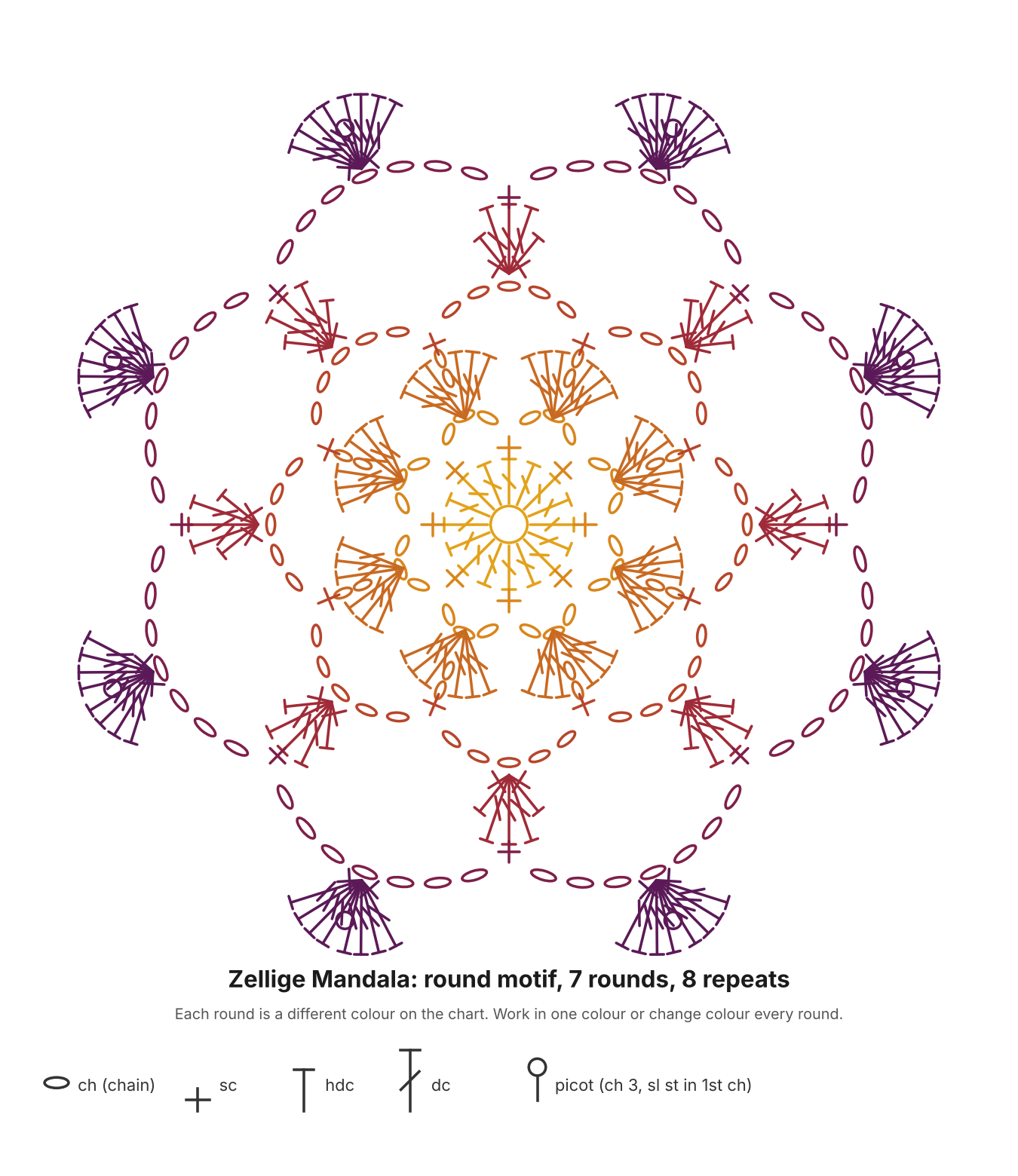
- Foundation. Ch 3W+3. (Size M: W = 80, so ch 243.)
- Row 1 (blocks). Dc in the 4th ch from hook and in each ch across. [W bl]
- Space rows. Ch 3, turn. *Ch 2, skip next 2 sts, dc in next st*; rep from * across, last dc in the top of the turning ch-3. [W sp]
- Block rows. Ch 3, turn. Dc in each dc and 2 dc in each ch-2 sp across, last dc in the top of the turning ch-3. [W bl]
Level 2: Lattice band
In Rows 3-8, work lattice rows 1-6: ch 3, turn, E1 sp, the lattice row q times, E2 sp. E1, q and E2 are in the skirt table.
Level 3: Zellige Star band
In Rows 4-18, work the star chart (chart row n is skirt row n+3). Every row is: ch 3, turn, then *G sp, one star row*, repeated 4 times in total, then G sp. G is in the skirt table. Chart rows are symmetric, so you never need to reverse them.

| Chart row | One star (15 squares) |
|---|---|
| 1 | 7 sp, 1 bl, 7 sp |
| 2 | 6 sp, 1 bl, 1 sp, 1 bl, 6 sp |
| 3 | 2 sp, 4 bl, 3 sp, 4 bl, 2 sp |
| 4 | 2 sp, 1 bl, 9 sp, 1 bl, 2 sp |
| 5 | 2 sp, 1 bl, 4 sp, 1 bl, 4 sp, 1 bl, 2 sp |
| 6 | 2 sp, 1 bl, 2 sp, 2 bl, 1 sp, 2 bl, 2 sp, 1 bl, 2 sp |
| 7 | 1 sp, 1 bl, 3 sp, 1 bl, 3 sp, 1 bl, 3 sp, 1 bl, 1 sp |
| 8 | 1 bl, 3 sp, 1 bl, 5 sp, 1 bl, 3 sp, 1 bl |
| 9 | 1 sp, 1 bl, 3 sp, 1 bl, 3 sp, 1 bl, 3 sp, 1 bl, 1 sp |
| 10 | 2 sp, 1 bl, 2 sp, 2 bl, 1 sp, 2 bl, 2 sp, 1 bl, 2 sp |
| 11 | 2 sp, 1 bl, 4 sp, 1 bl, 4 sp, 1 bl, 2 sp |
| 12 | 2 sp, 1 bl, 9 sp, 1 bl, 2 sp |
| 13 | 2 sp, 4 bl, 3 sp, 4 bl, 2 sp |
| 14 | 6 sp, 1 bl, 1 sp, 1 bl, 6 sp |
| 15 | 7 sp, 1 bl, 7 sp |
Waist ties and finishing
- Ties (make 2). With the yarn still attached at a top corner of Row 40, ch until the cord measures 120 cm (47 in). Sc in the 2nd ch from hook and in each ch back, sl st into the corner, fasten off. Join yarn at the other top corner and repeat.
- To wear. Wrap the skirt around your hips with the hem at the bottom, bring one tie around to the front or side, and tie them together.
Finishing, blocking and care
- Weave in ends diagonally through the blocks, then back through a second time. Mesh shows loose tails, so leave a generous 10 cm tail.
- Wet block. Soak in lukewarm water for 10-15 minutes, press out the water in a towel without wringing, and pin flat to the finished measurements. For the shorts, lay them flat and tug the mesh square.
- Let it dry completely before unpinning. Cotton filet holds its shape after blocking.
- Optional: a light fabric stiffener on the hem band keeps the star crisp.
- Care: hand wash cool and dry flat. Do not wring or hang wet, because cotton mesh stretches under its own weight.
Troubleshooting filet crochet
My square count keeps changing
Count the double crochet posts, not the chains. A row of W squares has W+1 posts, and the last one goes into the top of the turning ch-3. Put a stitch marker in the turning chain so you can find it. Most count problems come from missing that last stitch.
The edges are wavy
Wavy edges mean a changing tension at the turn. Keep your turning ch-3 the same size as your dc posts, and always work the last dc into the top (3rd ch) of the turning chain. If the edge pulls in, you are probably skipping that last stitch.
The star looks wider than tall
Filet squares are slightly wider than tall, so motifs look a little stretched before blocking. Wet blocking and the weight of the cotton open the mesh vertically. Block the skirt flat to its finished measurements.
There is a small gap at the crotch of the shorts
Both legs share the same two stitches at the front and back of the crotch, so a small gap can appear. Close it with a yarn tail and a few stitches.
The fabric is too stiff or too holey
Too stiff: go up half a hook size. Too holey or floppy: go down half a hook size. Swatch again before you start the garment.
Variations and ways to wear the set
- Crochet skirt only. Part 3 stands on its own as a free crochet skirt pattern with a star hem.
- Crochet top only. The halter top is a fast project and a great way to test your gauge before the skirt.
- Crochet shorts only. Make them in a darker colour to wear over a swimsuit.
- Two colours. Work the border rows, edging and ties in a contrast colour.
- Change the length. Add or remove rows. Each row adds about 1.25 cm (0.5 in).
- Style it. Wear the set over a swimsuit, or wear the top with jeans and the skirt with a plain tank. Add a sun hat to finish the look.
Related free patterns and beginner guides
- 3 Free Crochet Mesh Top Patterns (Video) 2026: more open-weave tops to try next
- Crochet Floral Net Cap: Free PDF Download: a matching openwork cap for your set
- 5 Free Granny Square Tote Bag Patterns: a beach bag to carry it all
- The Ultimate Beginner Crochet Guide
- How to Crochet a Magic Ring and a Flat Circle
- Browse the Free Crochet Patterns library
Frequently asked questions
Is this crochet set pattern really free?
Yes. The complete written pattern for the top, shorts and skirt is on this page. The printable PDF, with the charts and all size tables, is free when you sign up with your email.
Is filet crochet good for beginners?
Yes. Filet uses only chains and double crochet, and every square is either an open space or a solid block. If you can chain and make a double crochet, you can make Level 1 of this set. The ultimate beginner crochet guide on this site covers those two stitches step by step.
What hook size should I use for this crochet set?
Start with a 3.5 mm (US E-4) hook and DK cotton, then make the swatch in the gauge section. The pattern is written in squares, so your swatch decides whether you need a 3.25 mm, 3.75 mm or 4.0 mm hook.
How much yarn do I need for the whole set?
About 530 to 870 metres (580 to 950 yards) of DK cotton, depending on size. Size M needs roughly 630 metres, or about 275 g. These are estimates, so buy 10 to 15 percent extra.
Is the crochet set see-through?
Yes, filet is an open mesh. It is designed as a cover-up to wear over a swimsuit or a bralette and shorts. For a more opaque look you can wear a slip or lining underneath.
Can I make just the skirt, the top or the shorts?
Yes. Each piece is a stand-alone pattern with its own size table. Many people start with the skirt because it is a simple rectangle.
How do I read a filet crochet chart?
Each box on the chart is one square. A filled box is a block (3 double crochet). An empty box is a space (ch 2, skip 2, dc). Start at the bottom row and work up. The Zellige charts are symmetric, so each row reads the same from either side.
What is the difference between crochet and knitting?
Crochet uses one hook and works one active loop at a time. Knitting uses two needles and keeps many loops live at once. Crochet is usually easier to start and to fix, which is one reason it suits beginners.
How do I change the size?
Use the resizing formula in the gauge section: squares needed = measurement in cm x squares per 10 cm in your swatch / 10. Then use that number of squares wherever the pattern says W or N.
Can I sell items made from this pattern?
Yes, small-batch sales of finished items are welcome. Please credit Pattern by Ichraq Crea Studio and link back to this page. Please do not copy, resell or share the pattern, charts or photos.
Happy crocheting from Ichraq Crea Studio! Share your finished Zellige set on Instagram and tag us @IchraqCreaStudio. Pin this pattern to your crochet board so you can find it again.